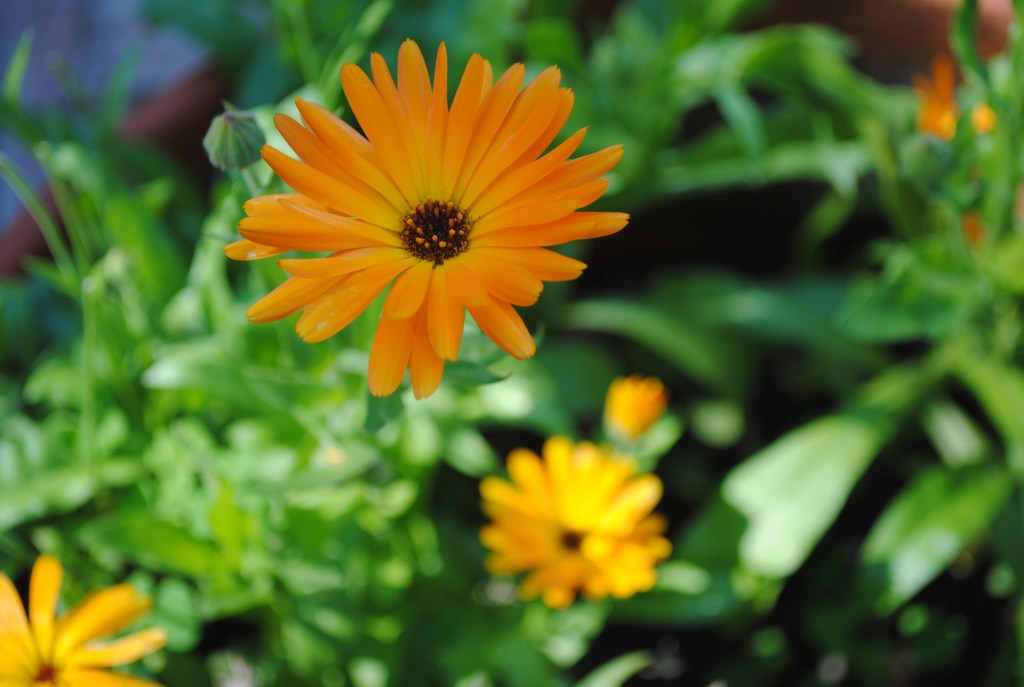
The Metamorphosis of Plants from 1790
Johan Wolfgang von Goethe has always stood out to me as an impactful figure in literature and philosophy. When studying drama his masterpiece, Faust, is unavoidable and it’s themes of power and love still resonate in contemporary storytelling. In addition he made a lasting impact on German cultural life with his advocacy of education and critical thinking. I was, however, oblivious to his scientific contributions to botany and was delighted to discover his deep passion for nature and plants expressed in The Metamorphosis of Plants from 1790.
At the time botany was evolving as a field of research and mainly preoccupied with classifications and terminology. Goethe, however, took a different approach that connects with contemporary science and quantum thinking. His research was elaborate and consisted of several approaches; observation and description, experimental manipulation (such as grafting and pruning) and mathematical analysis, ie exploring concepts like geometry and proportion to understand underlying patterns. Here, it would seem, seeds are sown for fractal observation. Yet his studies did not stop there. He was strongly convinced that there was an underlying force behind the obvious developmental observations.
“The infinite freedom of the growing leaf.
Yet nature bids a halt; her mighty hands,
Gently directing even higher perfection,
Narrow the vessels, moderate the sap;
And soon the form exhibits subtle change”.
Meticulously studying plants from their birth until death and beyond Goethe proposed that plants undergo transformations, a metamorphosis, in their development. He saw that plants were constantly developing towards ‘something’, which he came to describe as the Devine. In Goethe’s understanding there exists a plant ‘blueprint’, the ‘Urpflanze’, universal plants to which all plants are evolving towards. An understanding of the world that is echoed in philosophers from Plato to Emmanuel Kant. Though this could be seen as more of a metaphysical hypothesis, quantum particle theory does sneak into mind, because both operate with concepts that exist but cannot be observed in their pure form.
Goethe states that there are three kinds of metamorphosis: Regular – the plant has a consistent striving towards the goal of metamorphosis, irregular – the plant evolves irregularly, without an ‘inner force’ and accidental – maybe easiest described as ‘freaks of nature’ that Goethe did not wish to get distracted by. In his law of metamorphosis he states that the leaves form the dynamics from which the plant grows. Viewed through a quantum lens, again, this observation could be a form of a fractal understanding. Goethe writes: “The whole reflected each separate part” in the poem The Metamorphosis of Plants. When observing plants it is clear that ‘something’ is constantly evolving but ‘something’ always remains the same, recognisable.
To know the plant in detail, almost intimately, was part of Goethe’s methodology but subsequent to that observing the whole plant was paramount. Truly observing it, not as merely a collection of plant parts: leaf, petal, stamen, pistil, stem etc. but as an expression coming into existence. He states: “The Divinity works in the living, not in the dead; in the becoming and changing, not in the become and fixed”.
In order to experience the metamorphosis, the striving towards the Devine, the observer is required to access what Goethe called the Understanding, which encompasses both understanding and reason and possibly could be described as an intuitive perception.
The Metamorphosis of Plants contains stunning observations and deeply moving descriptions of the existence of plants crafted by one of Germany’s greatest wordsmiths. Therefore I cannot help but pay special attention when, in the latter part of his life, Goethe concluded that “people should talk less and draw more”. And when connecting to plants, drawing seems an open and intuitive way of understanding them. The drawings don’t have to be botanically accurate or aesthetically beautiful but rather an expression of a connection. Of the Devine life that lies within.
Sources:
The Metamorphosis of Plants, Johann Wolfgang von Goethe, MIT press 2009
New Eye’s for Plants, Margaret Colquhoun & Axel Ewald, Hawthorn Press 2011

 Nina's Nib
Leave a comment